
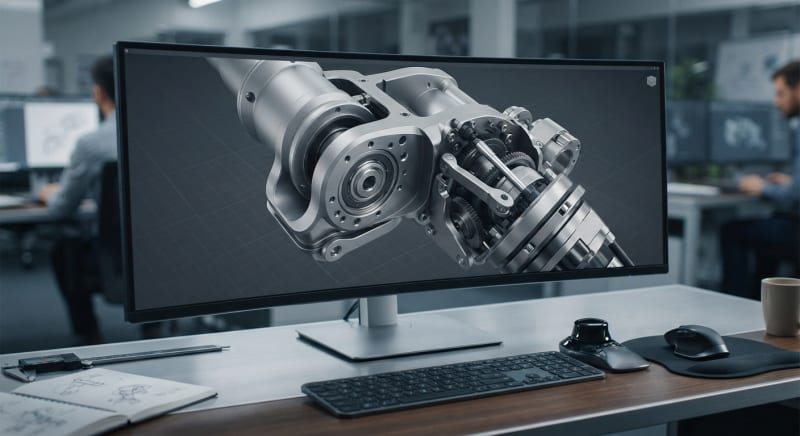
Choosing the right geometric foundation is an important decision when developing professional engineering applications. cad kernels provide the underlying technology needed to create, modify, analyze, and manage three-dimensional geometry. They can support solids, surfaces, curves, topology, and advanced modeling operations while allowing development teams to focus on application-specific functionality.
Not every application has the same requirements, so comparing CAD kernels should involve more than counting available features. Developers need to examine how each technology handles realistic engineering models, how it integrates with the application architecture, and whether it can meet expected performance and accuracy requirements.
Start With Application Requirements
The first step in comparing kernel technology is identifying what the application actually needs. A mechanical CAD system may require extensive solid and surface modeling capabilities, while a lightweight model viewer may need efficient geometry processing and visualization instead.
Other applications may focus on manufacturing preparation, simulation support, inspection, or model conversion. Defining the intended workflow helps development teams establish meaningful evaluation criteria.
Compare Solid Modeling Capabilities
Solid modeling is a fundamental requirement for many engineering applications. Developers should examine how candidate kernels handle primitive creation, Boolean operations, transformations, and modifications.
Complex models should be included in testing because simple shapes may not reveal important differences. Intersections, small features, and detailed components can place greater demands on geometric calculations.
The goal is to determine whether the technology can reliably support the types of models the final application is expected to process.
Evaluate Surface and Curve Functions
Surface and curve capabilities are important for applications involving complex product forms. Developers may need tools for creating, trimming, extending, joining, or transforming surfaces and curves.
A kernel with appropriate support for these entities can give applications greater flexibility when working with industrial designs, aerodynamic forms, or other complex geometry.
Testing should include representative curved models rather than focusing only on basic planar surfaces.
Examine Topology Handling
Geometry and topology work together in a CAD model. Geometry defines the shape, while topology describes relationships between faces, edges, and vertices.
When a model is edited, these relationships must remain consistent. Developers should therefore evaluate how candidate kernels maintain topology during Boolean operations, trimming, transformations, and other modifications.
Reliable topology management can be especially important for applications that perform frequent geometry editing.
Test Accuracy and Robustness
Accuracy is an important consideration for engineering software. Models may be used in manufacturing, simulation, inspection, or other downstream workflows where geometric consistency matters.
Developers can compare candidate technologies using difficult datasets containing complex intersections, small features, and detailed surfaces. Repeated editing operations can also reveal how reliably a kernel maintains model integrity.
Testing real engineering files provides more useful information than relying solely on sample models created specifically for demonstrations.
Compare Performance
Performance requirements can vary considerably between applications. A system handling individual components may have different requirements from one processing large assemblies.
Development teams should evaluate model loading, geometric operation speed, memory consumption, and responsiveness. Large datasets can help reveal potential bottlenecks.
Performance testing should reflect expected production workloads so that architectural decisions are based on realistic conditions.
Consider Integration
A kernel must fit into the broader software architecture. Engineering applications may combine geometric processing with visualization, file conversion, measurement, data management, and specialized analysis.
Developers should evaluate compatibility with their programming environment and deployment strategy. The ease with which kernel capabilities can be connected to other application components can affect development and maintenance effort.
Review Data Exchange Requirements
Many engineering applications work with models created in different software systems. Although file translation may be provided by separate technology, the kernel still needs to work effectively with imported geometry.
Teams should test representative models from the formats their users are likely to encounter. They should also determine whether relevant attributes, assemblies, and other model information need to remain available after translation.
Consider Long-Term Development
A kernel should be evaluated as part of the application's long-term architecture rather than only for an initial prototype. Documentation, maintainability, scalability, testing requirements, and future feature needs all matter.
A modular architecture can make it easier to extend the application as user requirements change. Developers should consider whether the selected technology can support both current and anticipated workloads.
Making an Informed Comparison
Comparing CAD kernels requires a structured evaluation based on actual application requirements. Solid and surface modeling, topology, accuracy, robustness, performance, integration, and data exchange should all be considered.
Rather than relying solely on feature lists, development teams can create realistic test scenarios using representative engineering models. This approach provides practical information about how each technology performs under expected conditions.
With careful evaluation and clear requirements, developers can select a geometric foundation that supports reliable 3D modeling while providing the flexibility needed to build specialized engineering applications. Core Technologies Behind Modern 3D CAD Engineering Software
#3DModeling #C3DConverter #CADConverter